

Table of Contents
- Key takeaways
- What are the best days to post on LinkedIn in 2026?
- What time should a B2B founder post on LinkedIn?
- What do the major studies say?
- Why do the studies disagree?
- When is the worst time to post on LinkedIn?
- Does posting time matter for a founder's personal profile?
- How do you find your own best time?
- How does the answer change for your situation?
- What about other platforms?
- FAQ
Last updated: October 18, 2026
BLUF: The best days to post on LinkedIn in 2026 are weekdays, and Wednesday is the one day every study rates well. Tuesday to Thursday is the safest block according to Sprout and Hootsuite, even though Buffer puts Tuesday low. The studies disagree on the hour by many hours, so use the shared window of late morning to late afternoon in your audience's local time as a starting point and test two slots inside it.
Key takeaways
- Weekdays beat weekends. Sprout Social and Hootsuite both name weekends as the worst days.
- Midweek is the safest bet. Sprout finds Tuesday to Thursday has the longest and most consistent peak windows, and Buffer ranks Wednesday first.
- The hour is contested. Sprout says 11 a.m. to 5 p.m. on Tuesday, Buffer says 3 to 8 p.m. on weekdays, and Hootsuite says 4 to 6 a.m.
- All the times are in your audience's local time. Use your own clock by mistake and every study on this page misleads you.
- LinkedIn's own marketing team says this is not a black-and-white science and tells you to test.
- A short test on your own posts beats any average. The method is below.
What are the best days to post on LinkedIn in 2026?
Tuesday to Thursday, with Wednesday on top.
Sprout Social's 2026 analysis says Tuesday, Wednesday and Thursday have the most consistent and longest peak windows. Buffer's analysis of 4.8 million posts ranks Wednesday first, then Thursday, then Friday. Hootsuite names Tuesdays and Wednesdays.
Monday and Tuesday sit lowest in Buffer's data, with Monday the weakest. That puts Buffer at odds with Sprout and Hootsuite on Tuesday. Wednesday is the one day all three rate well.
Friday is a mixed case. Buffer lists Friday 3 p.m. and 4 p.m. among its top slots. Sprout shows Friday peaks too, but narrower: 11 a.m. and 1 to 2 p.m.
What time should a B2B founder post on LinkedIn?
Somewhere between late morning and late afternoon on a weekday, in your buyer's local time, is the safest first guess.
Sprout's best windows run from 11 a.m. to as late as 5 p.m. on Tuesday through Thursday. Buffer's best window is 3 to 8 p.m. on weekdays, with Wednesday 4 p.m. as the top slot. Those two overlap between about 3 and 5 p.m.
Hootsuite is the outlier at 4 to 6 a.m. Its research is localized across 118 countries, and the page carries 2025 data. Buffer also found that morning posts, 6 to 11 a.m., now get lower engagement than afternoon and evening posts.
For a founder selling to working professionals, that points to a test between 11 a.m. and 5 p.m. A later slot has some support from Buffer. An earlier slot has support from Sprout. Both are worth a try.
What do the major studies say?
Here are the studies side by side. All of them use the audience's local time.
| Source | Data | Best days | Best hours | Worst |
|---|---|---|---|---|
| Sprout Social (March 2026) | Nearly 2 billion engagements, 307,000 profiles, six networks, Nov 27, 2025 to Feb 27, 2026 | Tuesday to Thursday most consistent | Mon 1 to 2 p.m.; Tue 11 a.m. to 5 p.m.; Wed 11 a.m. to 4 p.m.; Thu 11 a.m. and 1 to 5 p.m.; Fri 11 a.m. and 1 to 2 p.m. | Weekends |
| Buffer (September 2026) | 4.8 million LinkedIn posts sent through Buffer | Wednesday, then Thursday, then Friday | 3 to 8 p.m. on weekdays. Top slots: Wed 4 p.m., Fri 3 p.m., Fri 4 p.m. | Monday weakest, then Tuesday. Mornings 6 to 11 a.m. lower. Weekends below most weekdays |
| Hootsuite (2025 data) | Localized across 118 countries | Tuesday and Wednesday | 4 to 6 a.m. | Weekends |
| HubSpot 2023 report, quoted by LinkedIn | Not stated in the roundup | Monday, Wednesday, Tuesday, in that order | 9 a.m. to 12 p.m., 12 to 3 p.m., or 3 to 6 p.m. | Not stated |
| Sprinklr, quoted by LinkedIn | Not stated in the roundup | Weekdays, Tuesday the most active | 10 to 11 a.m. and 12 to 1 p.m., Tuesday to Thursday | Not stated |
| LinkedIn in-house analytics | Not stated | Not stated | Activity rises before work, around lunchtime and in the early evening | Not stated |
Read the table by column. The Best days column agrees with itself more than the Best hours column does.
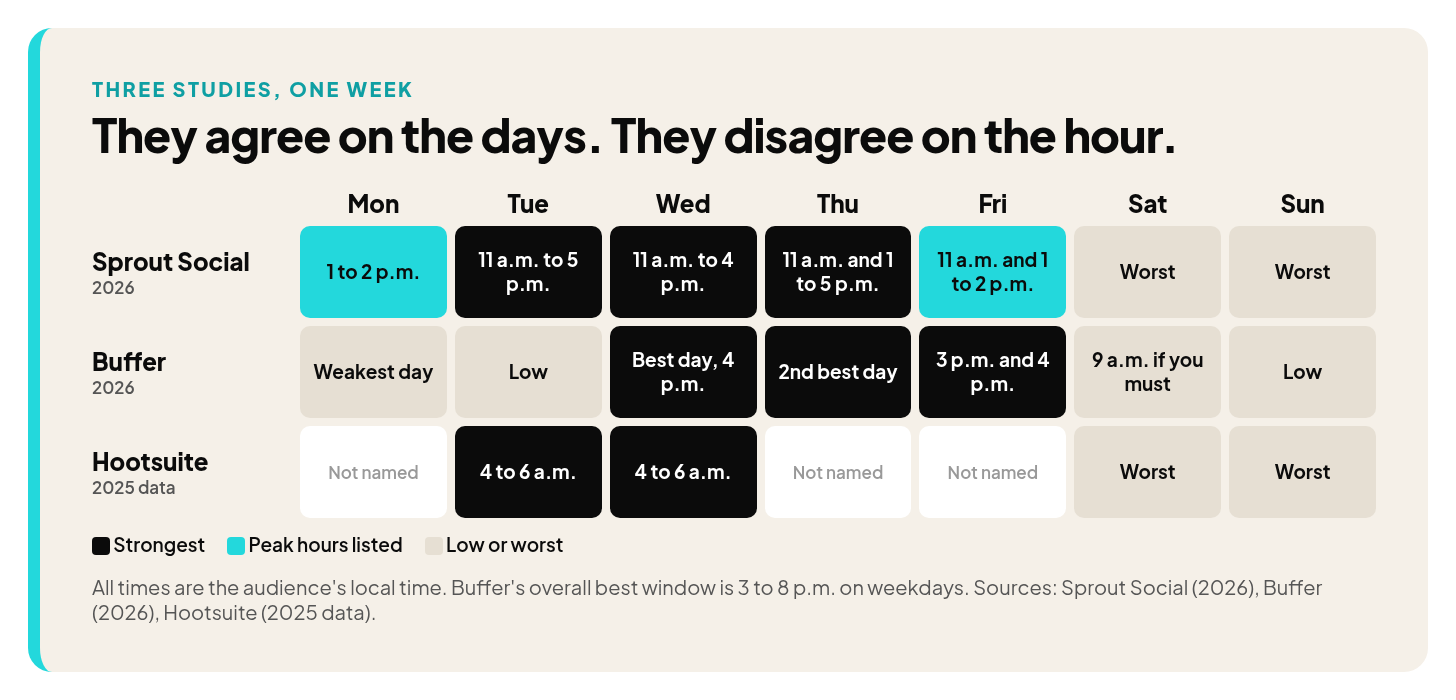
Week at a glance from three studies: Sprout Social 2026 peaks Tuesday to Thursday from 11 a.m., Buffer 2026 ranks Wednesday first with Monday weakest, Hootsuite 2025 data names Tuesday and Wednesday 4 to 6 a.m., and weekends are low or worst in all three.
Why do the studies disagree?
They measure different things at different times.
Sprout's window is November 2025 to February 2026, across six networks. Buffer's is 4.8 million posts that went out through Buffer's own scheduler. Hootsuite's headline comes from 2025 data. Three different populations and three different date ranges will not land on the same hour.
Time also moves the answer inside a single source. Buffer says its 2025 peaks sat inside working hours and its 2026 peaks moved later. A study from last year can already be stale.
The LinkedIn Marketing Blog says the same thing from the inside: the studies share common themes and also conflict. LinkedIn's team adds that it will not give you one universal time. Its advice is to find where your audience is located and test times relevant to their time zones.
Buffer adds a caveat that matters for anyone who wants to check these claims on their own account. LinkedIn has not confirmed an official "golden hour".
When is the worst time to post on LinkedIn?
Weekends. Sprout calls them the worst days and Hootsuite says weekends are typically the worst. Buffer finds weekends get less engagement than most weekdays, and if you must post on one, its pick is Saturday at 9 a.m.
Among weekdays, Buffer points to Monday as weakest, followed by Tuesday, and to mornings from 6 to 11 a.m. Sprout still lists Tuesday as strong and Monday 1 to 2 p.m. as a peak, so treat "worst" on a weekday as a hypothesis for your own test.
Does posting time matter for a founder's personal profile?
Some, and less than the format of the post.
None of the sources split their results by personal profile versus company page, so no study on this page can tell you your founder profile behaves differently. What they do show is that the day and window have a measurable effect on average engagement across very large datasets.
On one profile with a small audience, a weak post at a good hour is still a weak post. Your format and idea decide more than the clock. The LinkedIn format strategy breakdown covers that. Timing is the adjustment you make after that, and how the platform ranks dwell time is covered in the 2026 algorithm piece.
I believe you only get better by posting, seeing the data and seeing the results. I had a 266-day run of posting without stopping, and I learned a lot during it.
How do you find your own best time?
Run the two-week timing test. It takes six posts and a spreadsheet.
1. Pick your audience's time zone. Look at where your buyers sit and use that clock for every step, wherever you are. If your audience spans several, pick the biggest block of buyers.
2. Start from the shared window. The studies overlap on Tuesday to Thursday, late morning to late afternoon, local time.
3. Choose two slots inside it. One early, such as 11 a.m. One late, such as 4 p.m. Both sit inside Sprout's windows, and 4 p.m. is Buffer's top Wednesday slot.
4. Keep everything else the same. Same format, same length, same kind of topic. If the format changes, you are measuring the format.
5. Alternate the slots. Over two weeks, post three times, once per day from Tuesday to Thursday. Run the early slot on a given weekday in week one and the late slot on that same weekday in week two. This way no weekday gets a free advantage.
6. Log the exact time each post went live. LinkedIn shows "3h" or "2d" on a post and nothing precise, as Buffer points out. If you do not write the time down on the day, you cannot recover it later.
7. Check every post at the same moment. Forty-eight hours after posting is a clean checkpoint. Record impressions, comments and reactions for each one.
8. Compare the typical post. Take the middle result in each slot. One strong post can fake a trend.
Six posts is a small sample, so treat the result as a lean and run a second round before you change your schedule. The logging step feeds straight into measuring the results on a simple analytics dashboard. Frequency is a separate decision, and how often to post on LinkedIn has its own page.
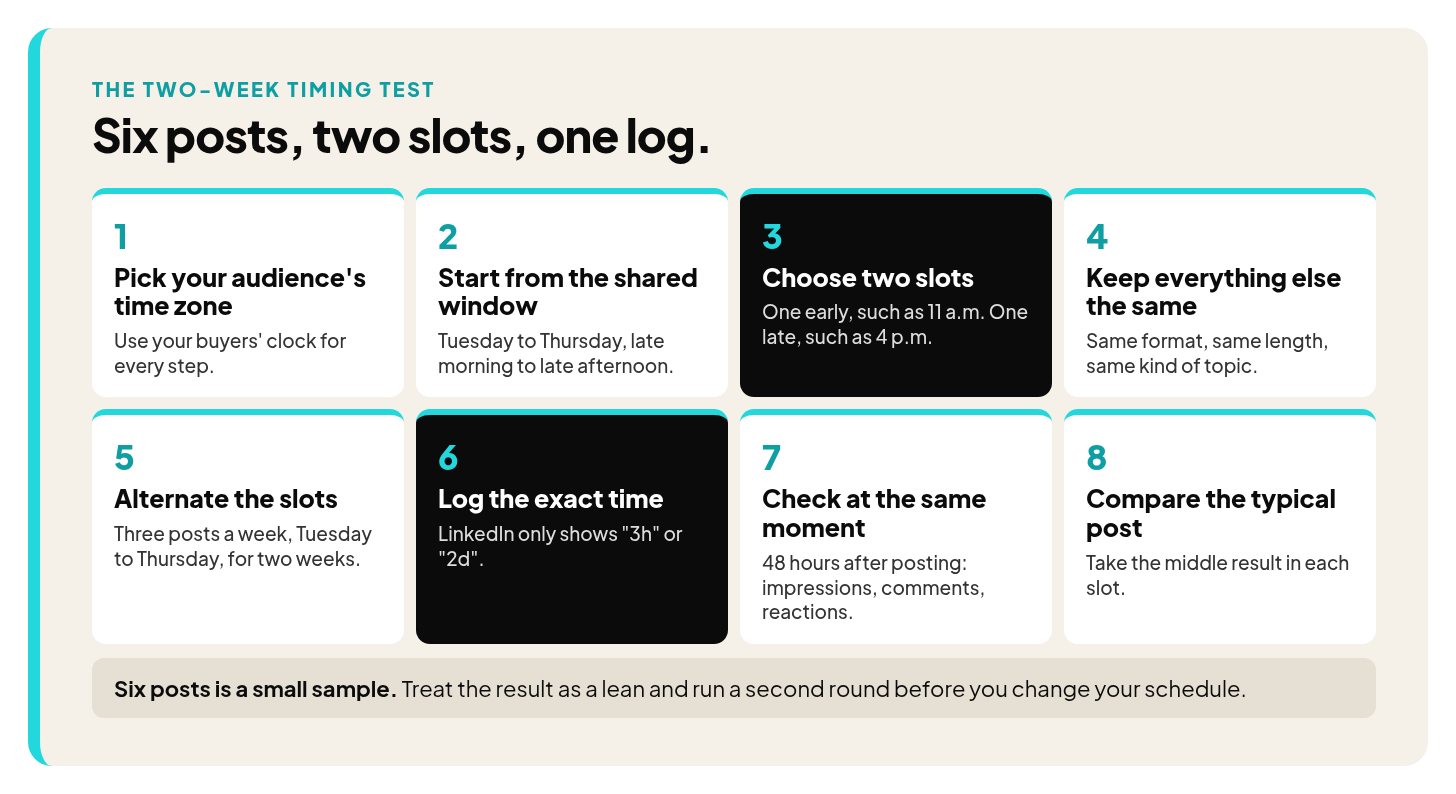
The two-week timing test in eight steps: pick your audience time zone, start from the shared window, choose two slots, keep everything else the same, alternate the slots, log the exact time, check at the same moment, compare the typical post.
How does the answer change for your situation?
Selling into one time zone. Everything above applies directly. Pick the clock your buyers live on and test inside the window.
Selling into several. Choose one primary region and test there first. A slot that lands mid-afternoon in one region lands at a different hour in another, and the test is not clean if you blend them. Run one region, then repeat for the next.
Posting from a different time zone than your buyers. A founder in Latin America or Europe selling to US buyers does the conversion first. The late slot of 4 p.m. in the buyer's city is a different hour on your clock. Check the offset, because it shifts when daylight saving starts or ends. Schedule the post instead of publishing live, so your own morning is not the constraint.
I work across time zones myself. I have a teammate in the Philippines, and I have clients around the California time zone, so I work with their schedule.
Posting solo versus with a ghostwriter who schedules. Posting solo, you control the hour and the log. With a ghostwriter or a scheduler, ask for the exact publish time of every post, because the scheduler knows it and LinkedIn will not show it. A weekly rhythm makes this easy to keep up. In Mentorship, we pick the ideas together and set your posting schedule in week three, then look at what landed on a call every other week. Decide how often to post and who your audience is first, using your social media strategy, then set the hour.
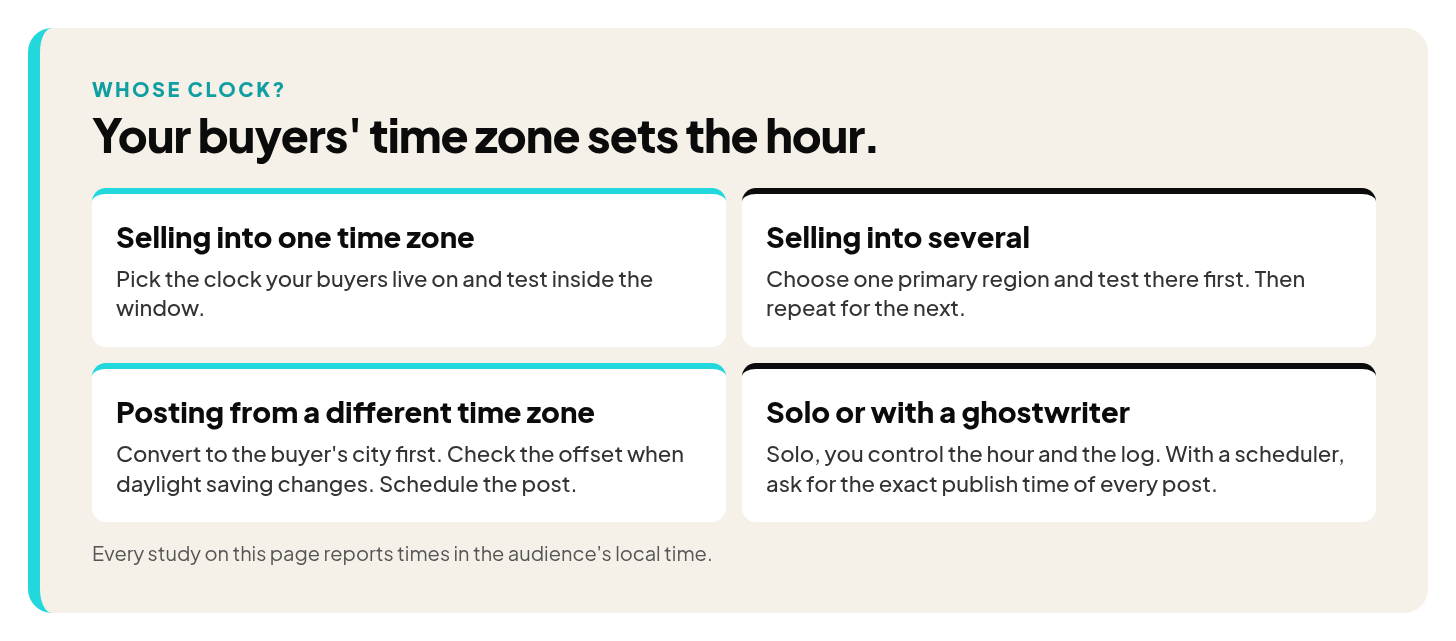
Whose clock sets the hour: selling into one time zone, selling into several, posting from a different time zone than your buyers, and posting solo or with a ghostwriter who schedules.
What about other platforms?
This page covers LinkedIn only. The studies above are LinkedIn data, and a LinkedIn peak does not carry over to a network with a different audience and a different habit of use. Sprout's dataset spans six networks, but the times quoted here are its LinkedIn results. Look up each platform on its own before you copy a schedule from this page.
FAQ
What is the best day to post on LinkedIn?
Wednesday. Buffer ranks it first, Hootsuite names it, and Sprout includes it in the Tuesday to Thursday block with the most consistent peaks.
What is the best time to post on LinkedIn for B2B?
Start with the shared window of late morning to late afternoon, local to your buyers, on Tuesday to Thursday. Sprout's best hours fall between 11 a.m. and 5 p.m., and Buffer's best slots fall between 3 and 8 p.m. Test one early and one late slot to see which fits your audience.
What is the best time to post on LinkedIn in 2026?
Buffer's September 2026 analysis gives Wednesday at 4 p.m. as the top slot, and Sprout's March 2026 analysis gives a broader Tuesday to Thursday window starting at 11 a.m. Hootsuite's 2025 data points to 4 to 6 a.m. instead. These conflict, which is the reason to run your own test.
What is the worst time to post on LinkedIn?
Weekends. Buffer also finds Monday the weakest weekday and morning posts from 6 to 11 a.m. lower than later in the day.
Should I post at the same time every day?
Consistent timing makes your log easier to read. Within the test, hold the slot fixed for each round so you know what you are comparing. After the test, there is no study here that says a fixed hour beats a good post, so keep the schedule you can maintain.
Do weekends ever work?
Weekends get less engagement than most weekdays in the sources above. If you must post on one, Buffer's pick is Saturday at 9 a.m. Treat that as a last resort and check it against your log.
Does LinkedIn have an official best time?
No. Buffer notes that LinkedIn has not confirmed an official "golden hour", and LinkedIn's own marketing team says the best time is always to be determined. Its advice is to test times relevant to your audience's time zones.
How long should I run a timing test?
Two weeks gets you six posts, which is a first read. Run a second round with the same two slots before you change your schedule.
If you want a second pair of eyes on your own numbers, you can Book a discovery call.
I'm Frank Velasquez. I'm Head of Content at a ghostwriting agency, and I run Mentorship on the side for four founders at a time. You can find me on LinkedIn.