Table of Contents
- Key takeaways
- Why does this page have "instagram" in the address?
- How does the LinkedIn feed work, in two steps?
- What are the three signal types LinkedIn names?
- What can a founder control, and what can't they?
- Which approach to the algorithm fits your situation?
- How does this change for different founders?
- What does this mean for your posting week?
- Why shouldn't you judge a post only by its likes?
- Which common myths does the public evidence answer?
- Where does this explanation fall short?
- FAQ
Last updated: November 2, 2026
What changed: this page used to cover Instagram's 2025 algorithm update. The readers here sell through LinkedIn, so it now explains how LinkedIn's feed decides what people see, using only LinkedIn's own pages and research.
The short answer. LinkedIn's feed works in two steps. First it pulls together a set of posts that could be relevant to a member, which is called retrieval. Then it puts those posts in an order for that one person, which is called ranking. Both steps lean on three kinds of signals that LinkedIn names: who the member is (identity), what the post is (content), and how the member behaves (activity). As a founder you cannot see or change the model. You can make your profile clear, write posts that say plainly what they are about, stay on topics your buyers care about, and keep the conversation under your posts worth reading. This page explains each step, what you control, and what to ignore.
If you want the news angle on what shifted this year, the page on why old LinkedIn tactics stopped working in 2026 covers it. This one is the evergreen explanation of how the feed decides.
Key takeaways
- The feed has two steps. Retrieval decides which posts are candidates for a member, and ranking decides the order that member sees them in.
- LinkedIn names three signal types: identity, content and activity. A founder influences identity and content directly.
- LinkedIn says payments to LinkedIn do not influence feed distribution, except promoted content, which is clearly labeled.
- Likes are one action among several, and LinkedIn also learns from what members read, return to and scroll past.
- Buyers often read without reacting, so a post should not be judged only by its likes.
- LinkedIn does not publish weights or exact rules, so any claim about a secret formula goes beyond the public evidence.
- No single approach suits every founder. Tricks, topic and profile clarity, and promoted content each fit a different goal, and only the second works on the inputs LinkedIn says it reads.
- Where you start depends on your situation. A new founder starts with identity and topic, an established founder checks topic drift and conversation quality, and a founder with silent readers looks beyond likes.
- The YSS three-signal check turns the identity, content and activity signals into six questions to run before you post.
Why does this page have "instagram" in the address?
This page used to cover Instagram's 2025 algorithm update. Since the readers here sell through LinkedIn, it now explains LinkedIn's feed. The address stays the same so existing links keep working.
How does the LinkedIn feed work, in two steps?
The simplest honest picture comes from LinkedIn's engineering blog post on its next-generation Feed, published in March 2026. LinkedIn describes a new ranking system powered by large language models that tries to understand what a post is actually about and how it relates to a member's changing interests and career goals.
Step one: retrieval
Retrieval answers the question of which posts should even be considered for this person right now. LinkedIn's help page on relevance says the Feed includes posts from your connections, people and companies you follow, groups you belong to, and relevant updates from outside your network.
According to the engineering post, LinkedIn replaced several separate sources with one retrieval system built on a language model. The older sources included a chronological network index and trending posts. The new system understands that topics are related even when the words differ. LinkedIn's own example is that a member interested in electrical engineering may also care about small modular reactors.
The model reads more than the words. LinkedIn says the prompts it builds for each post include the format, the author's name, headline, company and industry, engagement counts, article metadata and the post text. It also says a post's representation is updated within minutes of publishing or gaining engagement.
For suggested content from outside a member's network, a LinkedIn research paper on feed retrieval describes retrieving 2,000 candidates from a pool of hundreds of millions, based on the member's topical interests. That is the one number worth remembering. It shows that being a candidate is a narrow filter, and topic fit is what gets a post through it.
Step two: ranking
Ranking decides the order. The engineering post says LinkedIn's Generative Recommender model treats a member's feed history as a sequence and processes more than a thousand past interactions. It predicts passive actions such as a click, a skip or a long dwell, and active actions such as a like, a comment or a share.
A second LinkedIn research paper on feed ranking describes a transformer-based sequential ranking model that replaced the previous ranker and serves the majority of Feed traffic. In plain terms, the ranker looks at what a given person has done over time and estimates what they are likely to do with each candidate post.
LinkedIn also says its ranking relies on professional signals and engagement patterns, never demographic attributes, and that it audits whether posts from different creators compete on equal footing.
What are the three signal types LinkedIn names?
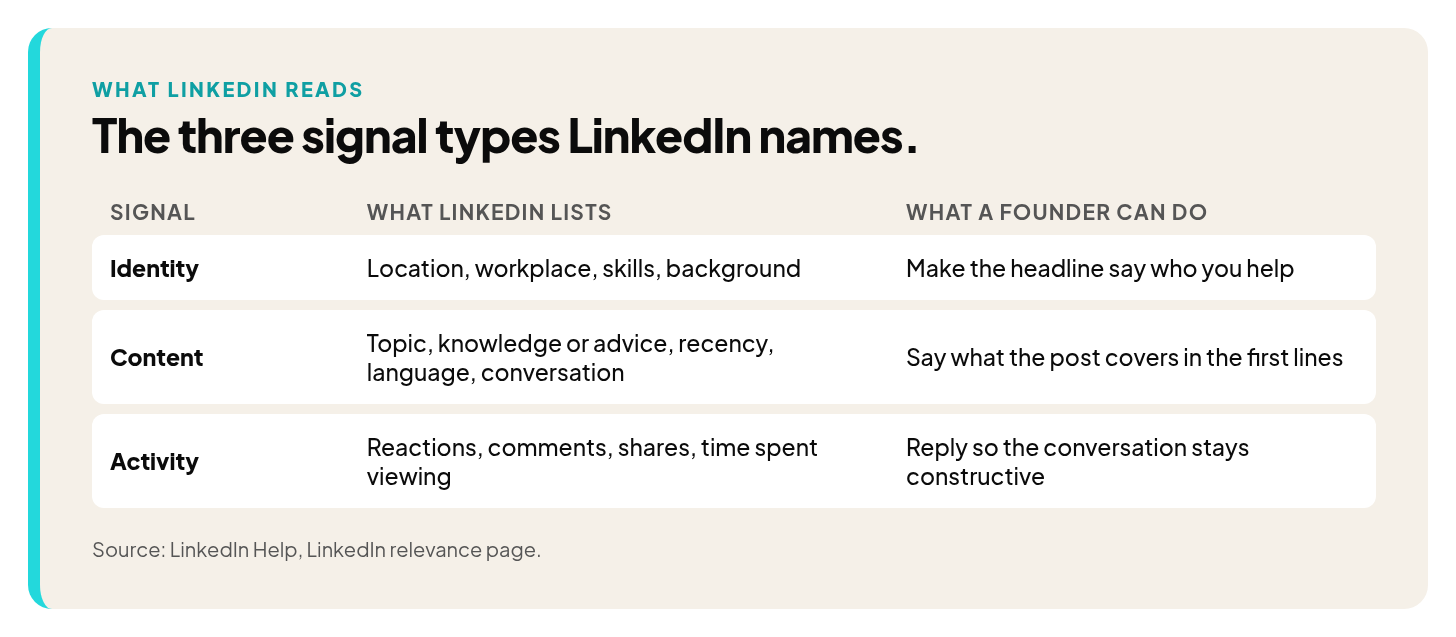
LinkedIn's help page says it evaluates three main types of signals. Here is each one, with what it means for a founder's posts.
| Signal type | What LinkedIn says it includes | What it means for a founder's posts |
|---|---|---|
| Identity | Profile details such as location, workplace and skills, and professional background | Your headline, about section and experience tell the system who you are and who your posts are for. A vague profile gives it less to work with. |
| Content | How often a post is viewed or engaged with, what it is about and whether it provides knowledge or advice, how recent it is, whether it comes from someone the member follows or is connected to, the language, how constructive or professional the conversation is, and tagged people, companies or topics | A post that states its topic clearly and offers real knowledge or advice is easier to classify. The quality of the conversation under it is also listed as a signal. |
| Activity | What a member has reacted to, commented on or shared, who they interact with often or recently, the content they spend the most time viewing, who they follow, the topics they have shown interest in, and the engagement others have with your posts and how recent it is | This is mostly the reader's side. Your posts reach people whose past behavior suggests interest in your topic, and the engagement your own posts earn feeds back in. |
The engineering post adds that signals include how a member engages over time, including what they have read, liked, commented on, returned to, or simply scrolled past. The reader's behavior shapes their feed as much as your post does.
What can a founder control, and what can't they?
Advice about the algorithm often blurs these two lists together. Separating them saves effort.
| You can influence | You cannot control |
|---|---|
| Profile clarity: a headline and about section that say who you help and what you do, which feeds the identity signals | Which individual members see a given post, since ranking is personal to each member |
| Staying on topics your buyers care about, which supports topic matching in retrieval | Whether a reader scrolls past, reads to the end or comes back later |
| Writing posts that say what they are about, in the first lines and in plain words | How the model changes, since LinkedIn says it is rolling out new systems |
| Conversation quality in your comments, since LinkedIn lists how constructive or professional the conversation is as a content signal | Exact weights, since LinkedIn does not publish them |
| Consistency of topic, so the system and your readers learn what you are about | What other people post, and how much competes with you on a given day |
The left column is small and unglamorous. It is also the only part that responds to your effort.
Which approach to the algorithm fits your situation?
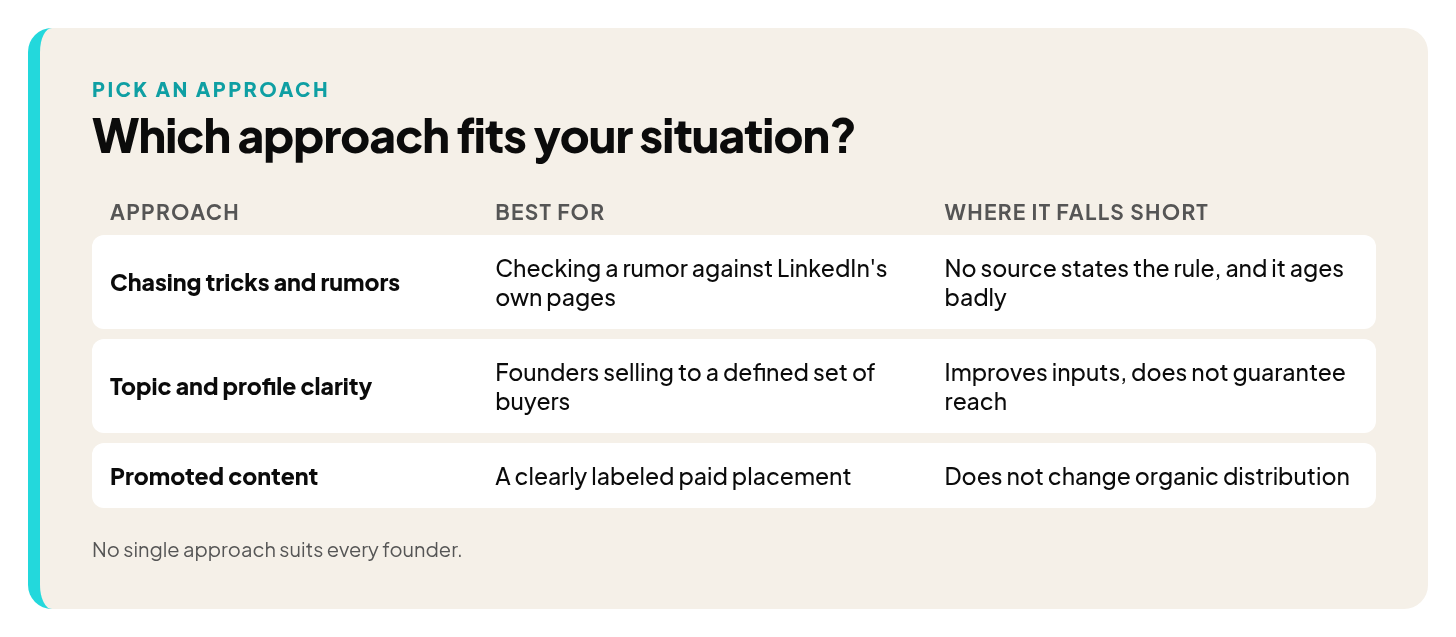
Founders tend to take one of three approaches. The table compares them using only what LinkedIn's pages and papers say.
| Approach | What the sources say about it | Best for | Where it falls short |
|---|---|---|---|
| Chasing algorithm tricks and rumored rules | LinkedIn does not publish the weights its models use, none of the four sources names a posting time, and the ranking paper describes a model that replaced the previous ranker | Founders who want to read a rumor and check it against LinkedIn's own pages before deciding whether to act on it | A rule that no source states cannot be verified, and a fixed rulebook ages badly when the model changes |
| Building topic and profile clarity | Identity, content and activity are the three signal types LinkedIn names, and retrieval matches posts to members by topic, including for suggested content from outside a member's network | Founders who post under their own name for a defined set of buyers and can look at results over several weeks | LinkedIn does not publish how much each signal counts, so clarity improves your inputs and does not guarantee reach |
| Paying for promoted content | LinkedIn says third-party payments do not influence feed distribution, except promoted content, which is clearly labeled | Founders who want a clearly labeled paid placement that sits alongside their organic posts | It does not change how your organic posts are distributed, and the sources say nothing about whether it leads to sales conversations |
Chasing tricks is the weakest fit for a founder who wants sales conversations, because the evidence behind it is thin and the system changes. Building topic and profile clarity is the better fit when your goal is to start conversations with a defined set of buyers, because it works on the inputs LinkedIn says it reads. Promoted content is the better fit when you want a separate, labeled paid channel and understand that it does not touch organic distribution.
No single approach suits every founder. Some founders reasonably combine the second and third, and the sources do not say whether doing so improves results.
How does this change for different founders?
The same signals apply to everyone, but the first thing to work on differs. These three cases use only what this page has covered.
A founder with a small network who is just starting
Best for: someone with few connections and a new posting habit.
Start with identity, because it is the signal you can fix in an hour. Make your headline and about section say who you help. Then pick two or three topics and stay inside them. LinkedIn's research describes suggested content from outside a member's network being chosen by topical interest, so topic fit is how a post can reach people who are not yet connected to you. Judge your first posts over several weeks and not one at a time.
A founder with an established audience whose reach has flattened
Best for: someone who already posts regularly and feels the numbers have stopped moving.
None of the four sources explains why reach flattens, so this page cannot diagnose it. What you can check is whether your recent posts have stayed on the topics your buyers care about, and whether the conversation under them is constructive, since LinkedIn lists that as a content signal. Compare a run of posts over several weeks. Keep in mind that the model also changes, which is outside your control.
A founder whose buyers read but rarely react
Best for: someone who gets conversations and sales from people who rarely like or comment.
Do not judge posts by likes alone. LinkedIn says its ranking model learns from passive actions such as long dwells and from what members read and return to, as well as from active actions. Focus on posts that say plainly what they are about, since a silent reader still decides in the first lines whether to keep reading. Judge over weeks, and look for the traces that silent readers leave in your messages and conversations.
What does this mean for your posting week?
None of these steps depends on a trick. They follow from how the system is described.
Start with your profile, because identity is one of the three signal types and it takes an hour to fix. Read your headline as a stranger would. If it does not say who you help and with what, rewrite it before you write another post.
Pick the two or three topics your buyers actually think about, and keep most of your posts inside them. Retrieval matches posts to members by topic, so a feed of unrelated posts gives the system a blurry picture of what you are about.
Write the first lines of each post so they say what the post covers. The system builds its understanding from the post text, and so does a busy reader deciding whether to keep going.
When someone comments, reply with something that moves the conversation forward. LinkedIn lists how constructive or professional a conversation is among its content signals, and a real exchange also gives your replies a chance to start a sales conversation.
Look at your results over several weeks rather than a single post. One post tells you little. A run of posts on the same topic tells you whether that topic holds attention. You only get better at this by posting, trying it, seeing the data, seeing the results, talking to people, engaging, seeing what people want.
The YSS three-signal check
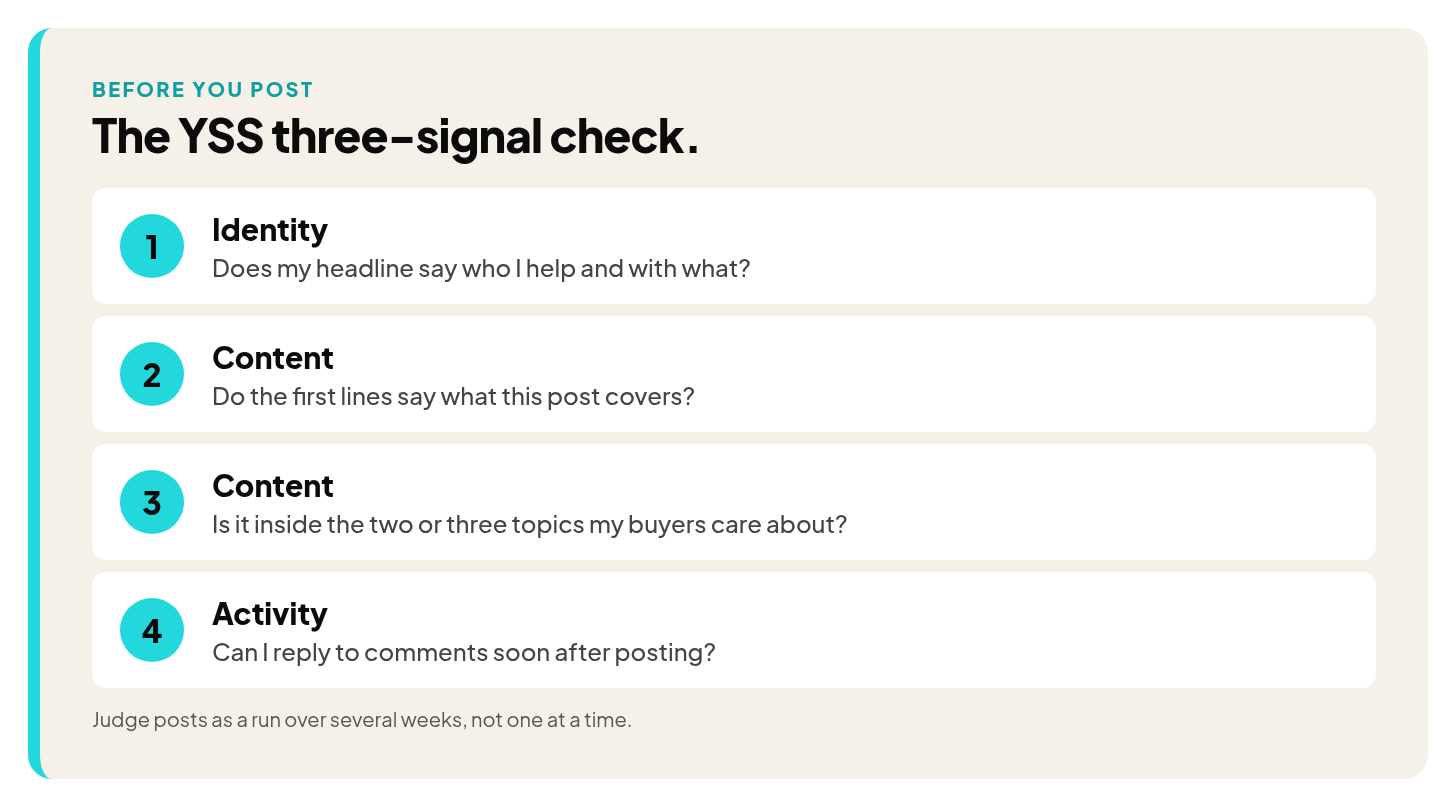
Here is a short checklist you can copy and run before you post. It is advice built from the three signal types on LinkedIn's help page, and it is not a tool from LinkedIn.
- Identity: Does my headline say who I help and with what, so my profile gives the system and a stranger the same clear picture?
- Identity: Does my experience and about section match the topics I am about to post on?
- Content: Do the first lines of this post say what it covers, and does it offer knowledge or advice a buyer could use?
- Content: Is this post inside the two or three topics my buyers care about, and is it written in plain language that suits the people I want to reach?
- Activity: Can I reply to comments soon after posting, with answers that keep the conversation constructive and professional?
- Activity: Am I looking at this post as one of a run of posts over several weeks, and not as a verdict on its own likes?
For the formatting side, the page on what 673,000 LinkedIn posts reveal about format goes deeper. For the difference between reach from your network and reach from suggested content, see in-network vs out-of-network reach.
Why shouldn't you judge a post only by its likes?
The feed responds to engagement, but your buyers may not behave the way the feed rewards. Here is what we see in client work. Most of the sales our clients get come from people who never engage with the content. They just watch.
One client runs an education business. Their down months on impressions are their best months on revenue. When a cohort is closing, the posts are reminders to sign up before the deadline, and those flop on reach. That is exactly when the business closes.
Another client is a CEO who keeps his network under 10,000 on purpose. He uses LinkedIn for business and not for a follower count, and he could name people he met and won business from through LinkedIn.
The feed still matters in both cases. Likes and impressions describe how the feed behaved, and your buyers may behave differently. If you want a way to see the traces that silent readers leave, the page on how to measure brand awareness on LinkedIn walks through it. For a related look at how deeper engagement is discussed, there is also this page on depth of engagement.
Which common myths does the public evidence answer?
Each answer below uses only what LinkedIn's pages and papers support.
"Paying LinkedIn boosts my regular posts." LinkedIn's help page says third-party payments to LinkedIn do not influence feed distribution, except promoted content, which is clearly labeled.
"There is a secret best time to post." None of the four sources gives a posting time. The engineering post does say a post's representation is updated within minutes of publishing or gaining engagement, which describes how fast the system refreshes and does not describe a window you can game.
"Only likes count." The engineering post says the ranking model uses long dwells, likes, comments and shares, and predicts passive actions such as click and skip as well as active ones. Likes are one action among several.
"The algorithm hides posts from people who are not famous." LinkedIn says its ranking relies on professional signals and engagement patterns and never demographic attributes, and that it audits whether posts from different creators compete on equal footing. You can reasonably ask for more proof than a company's own statement, but this is what is published.
"There is one algorithm that I can learn once." The engineering post describes a new system being rolled out in 2026, and the ranking paper describes a model that replaced the previous ranker. The system has already changed more than once, so a fixed rulebook will age badly. The page on LinkedIn algorithm rumors and why execution wins covers how to treat rumor-driven advice.
"Low-quality posts are simply ignored." LinkedIn's help page says its algorithms filter out or taper distribution of low-quality and unsafe content, so quality is part of distribution.
Where does this explanation fall short?
LinkedIn does not publish the weights its models use, so nobody outside the company can tell you how much a comment counts against a long read. Anyone who gives you a precise number is guessing or selling something.
The engineering post and the papers describe systems and goals. They do not give exact rules for what any single post should do. A description of how a model is built does not translate directly into a posting checklist, and the advice on this page is a reading of those descriptions.
The papers and the blog post are written by the company that runs the feed, so they show the intended design. They are not independent audits.
Things also change. The sources here are dated from 2025 and 2026, and a newer post from LinkedIn could make part of this out of date. The date at the top shows when this page was last checked.
FAQ
Does the LinkedIn algorithm punish founders who post under their own name?
No source here says so. LinkedIn says ranking relies on professional signals and engagement patterns and not on demographic attributes. Posting under your own name is a normal use of the feed.
Is there a best time or day to post on LinkedIn?
LinkedIn's published sources do not name one. Pick a time when you can reply to comments, since conversation quality is one of the content signals.
Do I need to pay for LinkedIn Premium or ads to get reach?
LinkedIn's help page says third-party payments to LinkedIn do not influence feed distribution, except promoted content, which is clearly labeled. Paid promotion is a separate product from organic distribution.
How does LinkedIn decide which of my posts to show someone?
It first retrieves candidate posts based on relevance to the member, including topic interest, and then ranks them for that person using their history of actions. Your posts are one input among many.
Do likes and comments matter more than reading?
The ranking model described by LinkedIn uses both passive actions, such as long dwells, and active actions, such as likes, comments and shares. LinkedIn does not publish how it weighs them against each other.
Why do some posts reach people outside my network?
The Feed includes relevant updates from outside a member's network, chosen by topical interest according to LinkedIn's research. Topic clarity in your posts helps that matching.
Can members choose how they see the feed?
Yes. LinkedIn's help page says members can choose Most recent first or Most relevant first as a sort option, so not every reader sees a ranked feed in the same way.
Should I hire a LinkedIn content coach for founders to deal with the algorithm?
You do not need one to apply this page, and you can work through it on your own. A coach can help if you want an outside read on your profile and topics.
I'm Frank Velasquez. I'm Head of Content at a ghostwriting agency. You can find me on LinkedIn.
If you want to talk through your own profile and topics, you can Book a discovery call.